Rugby Balls - What's the difference? Which one is right for me?
1. Supporter Balls versus Replica Balls
A Gilbert Replica Ball is available with your favourite country or club badge and colours on the ball and is perfect for practicing at home.
All Gilbert replica rugby balls are:
- Trademark Gilbert ellipses, synonymous with rugby
- Made with 3-ply backing material to ensure great shape retention.
- Standard Gilbert pimple grip pattern with a grippy rubber compound surface.
- High quality, hand-stitched, and feature a synthetic latex bladder for optimum air retention.
- All fully licensed and endorsed by our international and professional club partners
A great option if you are looking to show your support for your club or country, whilst having a high quality ball to throw around with your family or friends.
Shop the full Replica Ball range now
The alternative to our replica balls are Supporter Balls , which offer:
- A 2-ply backing material for good shape retention
- Standard Gilbert pimple grip pattern with a grippy rubber compound surface.
- A synthetic latex bladder for optimum air retention.
- All fully licensed and endorsed by our international and professional club partners
These provide the ideal option if you are looking for a fun and affordable piece of club or international branded memorabilia. Gilbert supporter rugby balls are perfect for backyard rugby with family and friends.
Shop the full Supporter Ball range now
2. Training Balls versus Match Ball
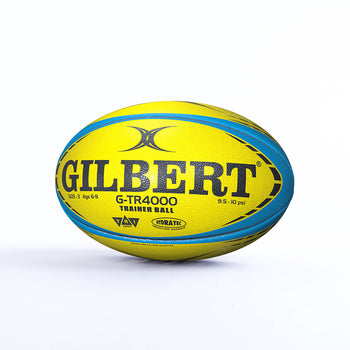
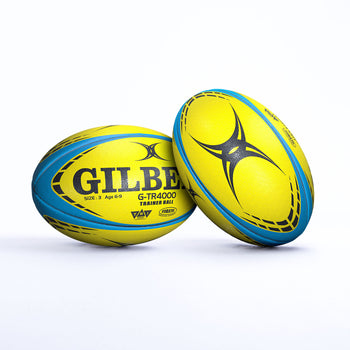
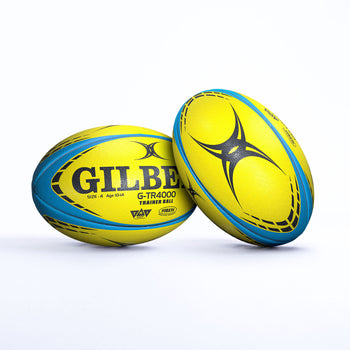
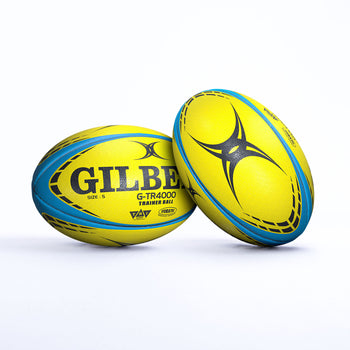
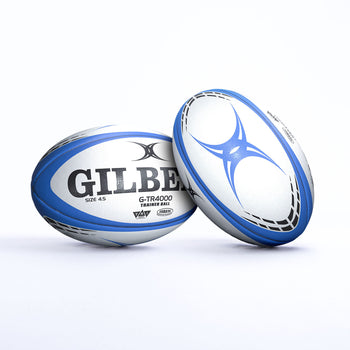
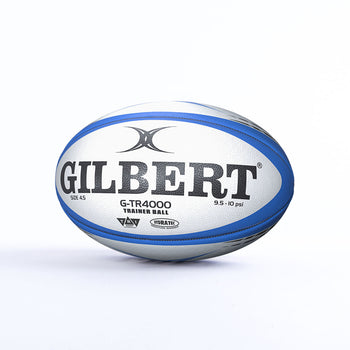
Gilbert Training Balls are made with cost and resilience in mind, so that they can withstand the rigours of multiple training sessions and across different surfaces. The life of any ball you choose to use can be extended by providing the proper care, which you can read about in our Rugby Ball care guide.
They all feature:
- A higher percentage of synthetic rubber rather than natural rubber which makes them more robust
- Hydratec moisture barrier to assist with moisture management
- A patented triangular surface grip pattern exclusive to our G-TR 4000 training balls
- A 3 ply backing material
Note: the G-TR 3000 training ball offers an affordable 2-ply training ball with the same Gilbert quality stamp of approval
Gilbert Match Balls on the other hand have been designed and produced with elite performance in mind. Due to their intended use, Match Balls are more expensive and therefore are often used in team run-throughs and matches rather than regular training sessions.
All Gilbert Match Balls are made with:
- More natural rubber, which naturally enhances the grip, essential for match play
- A patented Truflight™ valve, positioned in-seam. This in turn augments spin and flight.
- 3-ply backing material for optimum shape and energy transfer
- Hand-stitched for a perfect finish
- The iNNOVO Match Ball meets the highest standards for match play, guaranteeing quality and performance.
- The elite Sirius and Kinetica Match Balls include the Gilbert patented multi-matrix grip - the best grip of any rugby ball
- The Barbarian 2.0, Atom and Omega Match Balls include our popular standard grip - a quality hard wearing pimple
- All of these performance features make a match ball higher in price than a training ball.
Buying for your rugby club? Take a look at our Rugby Club Bulk Offers and you could save 40% on your new Rugby Balls and Rugby Equipment for the new season!
[button]
3. Rugby balls by age group
Rugby balls come in different sizes depending on the players’ age. This ensures handling skills are developed correctly and there is no difficulty in passing. The table below indicates the Gilbert rugby ball size against the appropriate age range.
|
SIZE |
AGE |
|
Size 3 (Mini) |
Under 7s, U8s, U9s |
|
Size 4 (Junior) |
Under 10s, U11s, U12s, U13s, U14s |
|
Size 5 (Adult) |
Under 15s and up. |
|
Other ball sizes available include: |
Super Midi (equivalent to size 2.5), Midi (equivalent to size 2), Mini (equivalent to size 1) |
4. Facts about Rugby Balls (source: World Rugby Laws)
- A rugby ball is oval and made of four panels.
- It weighs between 410-460 grams.
- Smaller rugby balls may be used for matches between young players.
- A rugby ball is made of leather or a suitable synthetic material. It may be treated to make it water resistant and easier to grip.
- Its air pressure at the start of play is 65.71-68.75 kilopascals, 0.67-0.70 kilograms per square centimetre or 9.5-10.0 pounds per square inch.